

Author: Dr. Andreas Fehlner, ONNX Steering Committee
The ONNX (Open Neural Network Exchange) community is proud to announce the release of ONNX v1.22.0, a landmark update that cements ONNX’s role as the backbone of modern generative AI infrastructure. From new attention operators that natively support large language model architectures to in-browser model validation via WebAssembly, this release reflects the community’s commitment to meeting developers where the frontier of AI is heading.
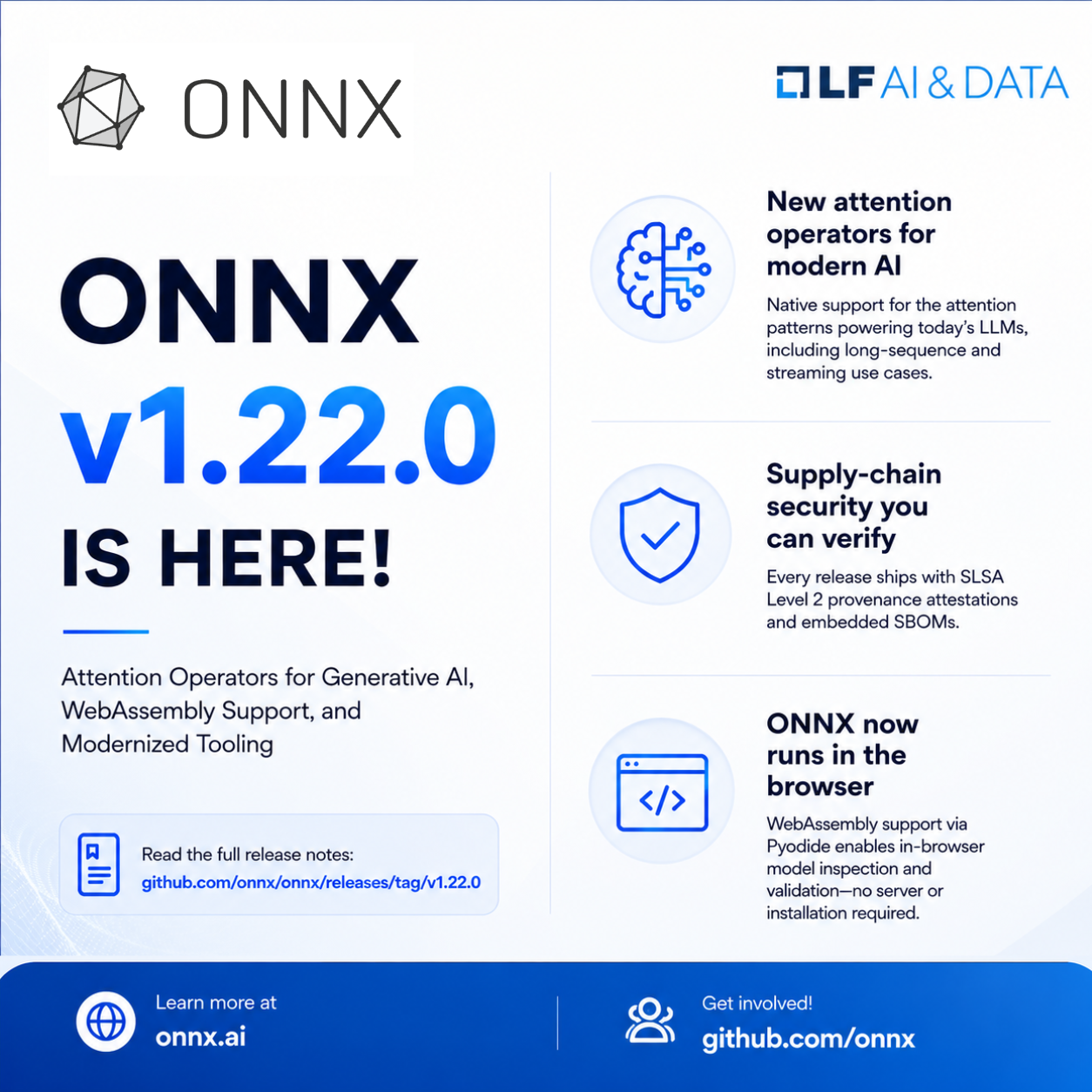
This release marks a major step forward for ONNX as the backbone of modern generative AI workloads, introducing new attention operators that directly support the architectures powering today’s large language models. A particular highlight is the supply-chain security hardening: every release now ships with SLSA Level 2 provenance attestations and an embedded SBOM, setting a new bar for trust in open ML infrastructure. On top of that, WebAssembly support via Pyodide opens up exciting new possibilities for in-browser model inspection and validation.
Read the full release notes on GitHub →
What’s New in ONNX v1.22.0
New Attention Operators for Modern AI Workloads
ONNX now natively supports the attention patterns powering today’s large language models, making it significantly easier to represent, exchange, and deploy cutting-edge AI architectures, including long-sequence and streaming use cases. For teams building on transformer-based models, this is the interoperability primitive they’ve been waiting for.
Supply-Chain Security You Can Verify
Every ONNX v1.22.0 release ships with cryptographic provenance attestations (SLSA Level 2) and a full Software Bill of Materials (SBOM) embedded at build time. Organizations operating in regulated environments or those with strict security requirements can now audit exactly what they’re deploying. No guesswork, no trust gaps.
ONNX Now Runs in the Browser
WebAssembly support via Pyodide means developers can inspect and validate ONNX models directly in a browser, with no server setup or local installation required. This lowers the barrier to entry dramatically and opens the door to new tooling experiences built entirely on the web platform.
Cleaner, More Reliable Builds Across All Platforms
A modernized build system makes releases more consistent and reproducible across Linux, macOS, and Windows. Whether you’re packaging ONNX for a downstream distribution or integrating it into a CI/CD pipeline, builds are now more predictable and easier to maintain.
Stronger Foundation for Framework Authors
Improved shape inference utilities and a more robust version converter make building on top of ONNX easier and more reliable. Framework authors and tool developers can now depend on a more stable foundation, with fewer edge cases to work around.
Wider Operator Correctness Guarantees
Key ONNX operators now match the specification for a broader range of real-world inputs, giving users stronger confidence when using ONNX as a reference implementation or for model validation across frameworks.
Why This Release Matters
What is ONNX?
ONNX is an open source format for representing machine learning models, enabling interoperability between frameworks like PyTorch, TensorFlow, and scikit-learn, and hardware runtimes from NVIDIA, Intel, Qualcomm, and more.
Who benefits from ONNX v1.22.0?
- ML engineers deploying LLM-based systems benefit directly from native attention operator support
- Security and compliance teams gain cryptographic proof of what’s in each release
- Web developers and educators can now work with ONNX models entirely in the browser
- Framework and tool authors get a more reliable base for building on top of ONNX
What’s Next for ONNX
The community’s near-term focus is on expanding ONNX operator coverage for generative AI, including probabilistic and Bayesian inference, alongside richer quantization support and further improvements to shape inference and the version converter. The ai.onnx.preview opset will continue to serve as the incubation ground for emerging operator patterns before they are standardized.
Get Involved
A huge thank you to the 27 contributors who made this release possible, including 16 first-time ONNX contributors. Every author, reviewer, and tester plays a vital role in keeping this community-driven project moving forward.
Now is a great time to get involved and help shape the future of open AI infrastructure:
- Visit onnx.ai to learn more
- Contribute at github.com/onnx/onnx
- Join community meetings and working groups at onnx.ai
