

By Dr. Andreas Fehlner, ONNX Steering Committee
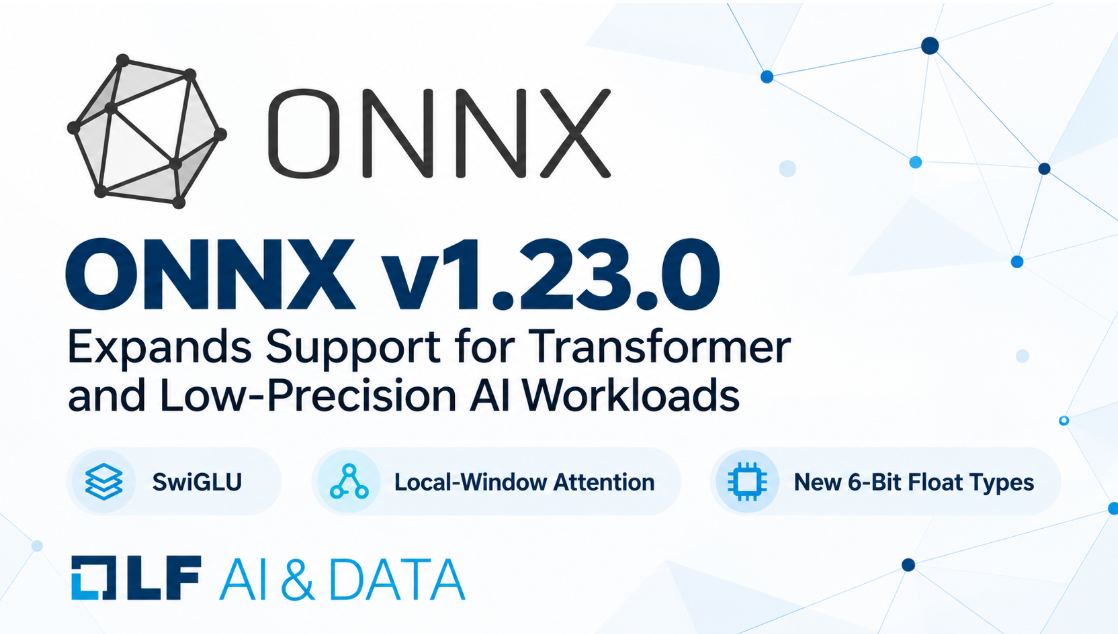
Modern AI architectures are evolving quickly, and exchanging them between frameworks and runtimes depends on ONNX being able to represent their operators, data types, and attention patterns accurately. I’m excited to share that ONNX v1.23.0, released on September 18, 2026, moves that work forward in a big way, with support for SwiGLU, local-window attention, new 6-bit floating-point types, and a long list of reliability improvements across shape inference, model conversion, and the reference implementation.
This release reflects the continued effort of our community to keep ONNX aligned with where the field is actually heading: larger transformer-based models, more efficient low-precision inference, and the everyday realities of converting and validating models across an increasingly diverse tooling ecosystem.
What’s new in v1.23.0
- Better coverage for transformer architectures: The new SwiGLU operator gives model producers and consumers a shared representation for an activation function widely used in modern neural networks. Attention updates add local windows and improve causal masking, explicit masks, external key-value caches, and bfloat16 handling.
- More options for efficient, low-precision models: IR Version 14 introduces the FLOAT6E2M3 and FLOAT6E3M2 tensor element types, including their serialized representation. Broader bfloat16 and signed-integer support helps more operators express lower-precision computation.
- A broader foundation for model representation: Updated operators such as Optional, Celu, Einsum, BitShift, SpaceToDepth, and Mod allow ONNX graphs to represent a wider range of values and model behavior.
- More dependable validation and conversion: Improvements to the reference implementation, checker, parser, shape inference, inliner, and version converter address malformed models and difficult edge cases, giving framework and tool developers more predictable behavior.
You can find the full release notes here: ONNX v1.23.0 on GitHub, and the complete set of changes in the v1.22.0 to v1.23.0 changelog.
What’s next
ONNX continues to evolve with the needs of the machine-learning community. What should ONNX support next, and where do current tools still make model conversion or deployment difficult? I’d love to hear your feedback and ideas, share them with us on GitHub or at one of the ONNX meetings listed on the project calendar.
Thank you
Thank you to the 28 contributors credited in the ONNX v1.23.0 release notes, as well as everyone who reviewed, tested, documented, and discussed the work behind this release. It’s this community effort that keeps ONNX moving forward.
