

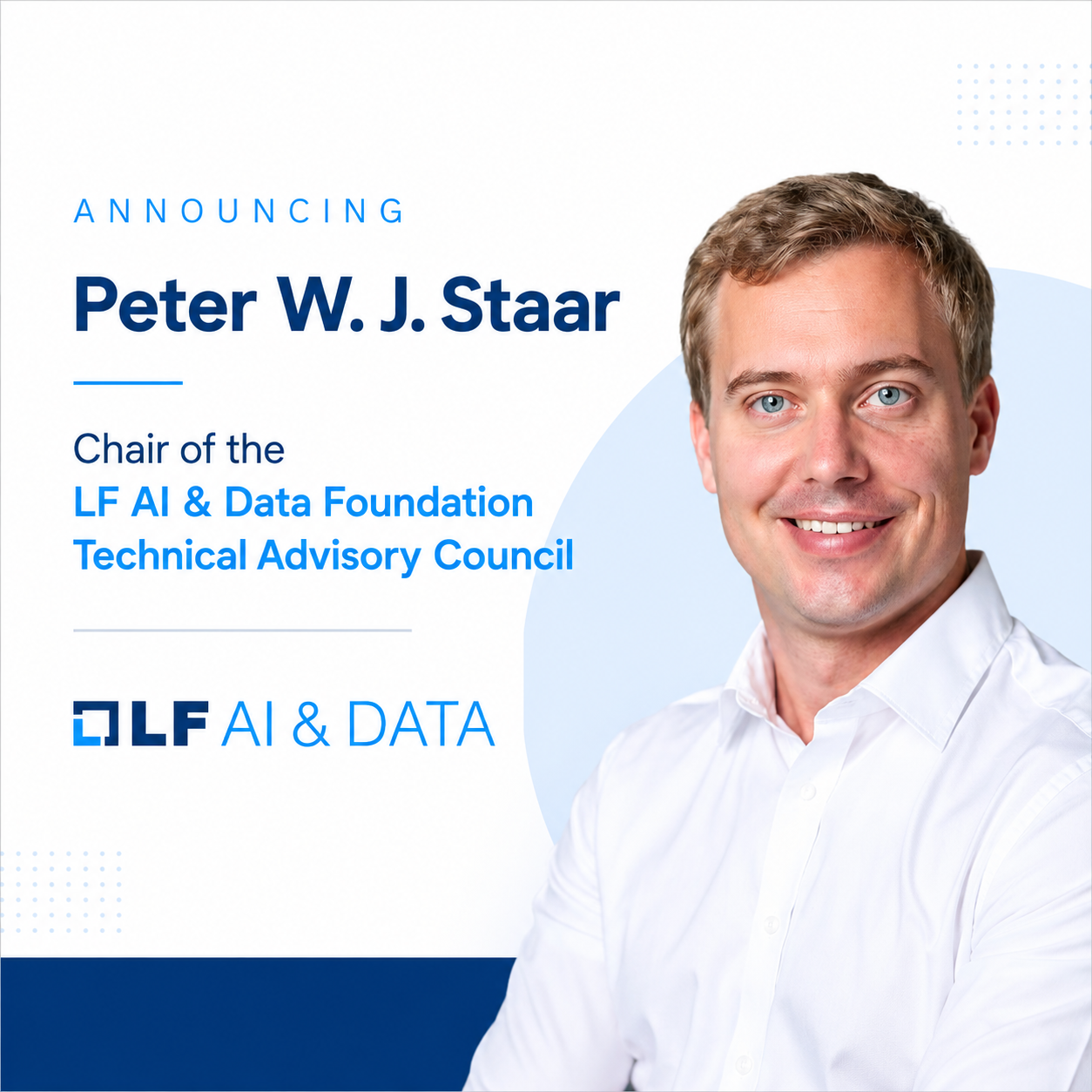
By Peter W. J. Staar, Chair of LF AI & Data Foundation Technical Advisory Council
AI is reaching the point where infrastructure matters as much as models. The decisions we make now—about standards, interoperability, governance, and open collaboration—will shape the ecosystem for years to come. As the newly elected Chair of the Technical Advisory Council of the LF AI & Data Foundation, I’d like to outline why I believe this is our most important challenge and an incredible opportunity for the LF AI & Data Foundation.
The problem I keep running into
I have spent the better part of a decade working on how AI systems can understand and use knowledge from real documents. Scientific papers, technical reports, enterprise records, regulatory filings. Documents that hold enormous amounts of valuable information but are notoriously hard for machines to read well.
What I have learned, over and over, is that the model is rarely the bottleneck these days. The bottleneck is context. Getting the right information, in the right structure, to the right part of the system at the right time. That is the hard problem, and it is one the field has not yet solved in a principled, open way.
As AI moves toward agentic systems that reason, plan, and act across long horizons, this problem only becomes more pressing. Agents need grounding. They need to connect to knowledge that is current, structured, trustworthy, and interoperable. Without that, even the most capable model is working in the dark.
This is what I think of as the context layer. And it is largely still missing.
Why open source is the right answer here
I want to be clear that my conviction about open source is not ideological. It is practical, and it comes from experience.
Context technologies sit underneath everything else. Document parsing, metadata standards, knowledge representation, retrieval, data lineage. These are foundational pieces of infrastructure, and foundational infrastructure works best when it is built in the open, governed by community consensus, and composable across different stacks and use cases. When it is proprietary, you get fragmentation. You get lock-in. You get incompatible silos that make it harder, not easier, to build reliable AI applications.
We have seen this story play out before. Linux, Kubernetes, the Apache ecosystem. These succeeded not because any single company owned them, but because a community of people decided the infrastructure layer was too important to leave to any one vendor’s roadmap. I believe the same logic applies here.
And the timing matters. Enterprises are making infrastructure decisions right now. The formats and standards they adopt today will be with them for years. If we do not build open, interoperable alternatives early, we will spend the next decade cleaning up fragmentation that could have been avoided.
What Docling taught me
One project that has shaped my thinking on all of this is Docling, which I have had the privilege of helping build and grow within the Linux Foundation.
Docling does something that sounds simple on the surface: it takes unstructured documents and turns them into structured, machine-readable representations that AI systems can actually work with. PDFs, Word documents, presentations, HTML. The kind of content that holds most of the world’s enterprise knowledge but that standard AI pipelines struggle to handle reliably.
What has been most rewarding is watching how the community has taken Docling and run with it. People are building on top of it in ways we never anticipated. It is being used in retrieval pipelines, knowledge graph construction, document-grounded agents, and enterprise AI systems across industries. That is what good open infrastructure does: it enables things its creators did not foresee.
Perhaps the most important lesson from Docling, however, is that parsing documents is only half the problem. If every parser, framework, or application produces its own representation of a document, interoperability remains out of reach. AI needs not only better tools for understanding documents, but also a common way to represent what those tools discover.
That realization led us to create DocLang, an open, AI-native document format developed through an open standards process. The goal is not to replace Docling or any other parser, but to provide a shared representation that preserves document structure, semantics, provenance, and metadata across different tools, models, and organizations. Just as HTML gave the web a common language for documents, I believe AI needs an open language for context. You can learn more at DocLang.ai.
Docling is one building block in the context layer. DocLang is another. Together they represent a broader shift: moving from isolated document processing tools toward shared infrastructure for context. There are many more pieces to build, and many more projects across the LF AI & Data ecosystem that are tackling complementary problems. My hope is that we can connect these efforts more intentionally and help the whole become greater than the sum of its parts.
What I want to focus on as TAC Chair
I have three priorities in this role, and I want to be straightforward about them.
Growing the foundation’s focus on context and knowledge technologies. The LF AI & Data will become the natural home for projects working on document understanding, metadata standards, knowledge extraction, and semantic interoperability. This work is less glamorous than training a new model, but it is just as important, and it is exactly where open collaboration creates the most durable value.
Building real connections across the Linux Foundation ecosystem. The problems we are trying to solve do not live neatly inside one foundation. Data provenance, supply chain integrity, interoperability standards: these challenges span LF AI & Data, CNCF, OpenSSF, and others. I want to invest real effort in making sure our work connects with what other communities are doing, rather than running in parallel.
Making it easier for people to contribute. The foundation’s greatest asset is its community. I want to lower the barriers for researchers, engineers, and organizations who want to get involved, whether they are just starting out in open source or are already deep in it. If you have a project that fits, or an idea for one, I want to help you find a home for it here.
Come build with us
If you are working on any part of the context layer for AI, whether that is document understanding, knowledge representation, metadata standards, retrieval, or agentic infrastructure, I would genuinely love to talk. Not in a formal, scheduled way. Just: reach out. Tell me what you are working on. Tell me where you are stuck. Tell me what collaboration would actually be useful to you.
This community is full of people doing important, underappreciated work. I want to help more of it happen in the open, where it can benefit everyone.
I am excited for what we will build together.

