

Author: Deborah Dahl, Principal at Conversational Technologies
LF AI & Data’s Open Voice Interoperability Initiative is excited to announce the release of Open Floor Protocol 1.1.0, expanding support for multi-agent conversations where multiple independent conversational AI agents can collaborate with a human user in real time.
This release is a major step forward for interoperable multi-agent systems, making it possible for agents developed with any AI technology and hosted by any organization to work together on real problems, as long as they can communicate using Open Floor Protocol messages. With 1.1.0, several agents can join the same conversation, contribute their own expertise, and react to one another while remaining completely separate, allowing each agent to maintain privacy and avoid rigid, centralized orchestration.
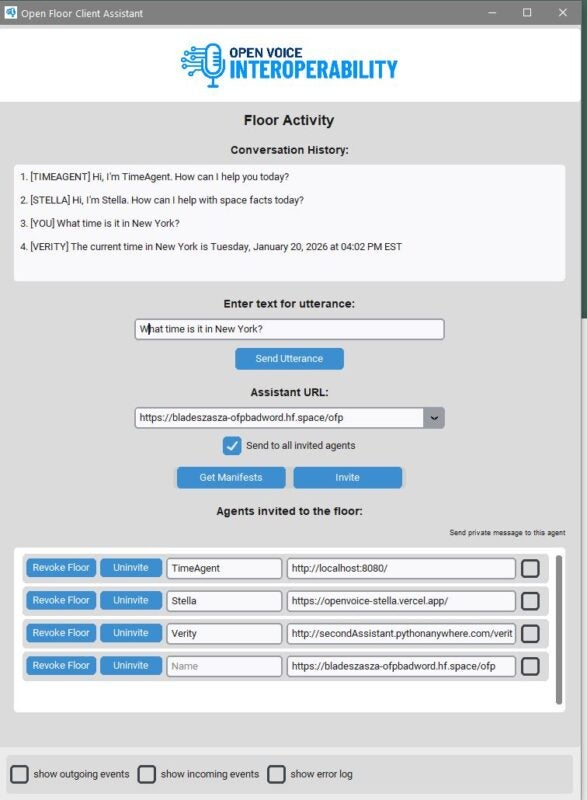
A shared conversation among four invited agents: a world time expert (TimeAgent), a space images expert (Stella), a hallucination checker (Verity), and a content moderator, collaborating with a human user in a single conversation.
Key Highlights of Open Floor Protocol 1.1.0
This release introduces enhanced multi-agent conversation capabilities, including:
- Multiple agents can join a user conversation at the same time
- Each agent can independently contribute to the discussion
- Agents can react to each other’s contributions in the shared conversation
- Agents are completely separate and can keep any private information away from the other agents
- Platform- and technology-agnostic design, supporting agents built on any stack
- Standard manifest support so agents can describe themselves and their capabilities in a consistent way
You can find the release documentation and materials here.
What’s Next?
The project team is now working on expanding the specifications with new capabilities, including agent discovery, multimodal communication, and media streaming. We are also excited to see how developers use Open Floor Protocol to build new applications enabled by multiple cooperating conversational AI agents, especially across organizational or platform boundaries.
We invite developers, researchers, and organizations to get involved. Visit our GitHub project, try out the specifications and sample code, and share feedback on what worked well and what could be improved.

