

This post was initially published on the PyTorch Foundation blog
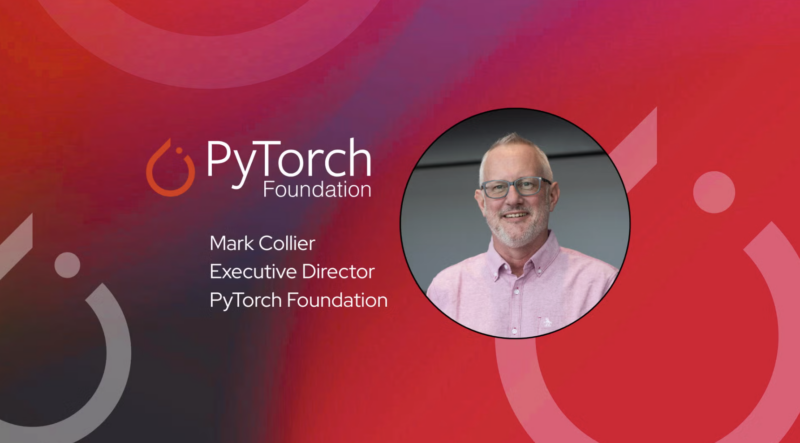
Mark Collier, General Manager, AI & Infrastructure, Linux Foundation & Executive Director, PyTorch Foundation
I want to start by thanking Matt White for everything he has built over the past two years. The growth of the PyTorch Foundation speaks for itself. What began as a single-project foundation is now a multi-project home for some of the most critical infrastructure in AI. That did not happen by accident. It is the result of real technical leadership, genuine community investment, and a clear belief in open collaboration. Matt is now stepping into the role of Global CTO of AI at the Linux Foundation and will transition to the role of CTO at the PyTorch Foundation, where he will focus on the technical strategy and direction that will define what’s possible next.
I’m thrilled to be joining the PyTorch Foundation as its new Executive Director. Here’s why.
The Most Important Open Source Projects in the World
There is not a more important open source project in the world right now than PyTorch. The daily onslaught of new state-of-the-art models proves it. When you hear about models writing compilers from scratch capable of compiling the Linux kernel, you’re getting a glimpse of the future that PyTorch makes possible.
But here’s what I think people outside of our community are only beginning to understand: the PyTorch Foundation is no longer just about PyTorch.
vLLM has become the inference engine of choice for the industry. When a new model drops, it runs on vLLM on day one, which tells us where the center of gravity lives. Inference is the largest workload in human history, and it runs on a PyTorch Foundation project.
DeepSpeed is pushing the boundaries of training efficiency at a scale that was unthinkable a few years ago. Ray is powering the orchestration and scaling layer that lets AI workloads run across the industry. These are foundational technologies with massive communities of their own, and they chose to make their home here.
Training. Inference. Orchestration. The critical layers of the AI stack live under one roof.
Every Innovation Story Is an Infrastructure Story
I’ve spent my career finding the infrastructure layer of emerging technology waves and building open source ecosystems around them. I co-founded OpenStack in 2010 and built the OpenStack Foundation (now OpenInfra Foundation), spending over a decade helping create the open source cloud. Last year we merged the OpenInfra Foundation with the Linux Foundation, and I became General Manager of AI and Infrastructure and Executive Director of the LF AI and Data Foundation. Now I get to put that experience into action with the PyTorch Foundation.
If there’s one thing I’ve learned across all of that, it’s that every innovation story is an infrastructure story if you know where to look. AI is going to reshape every aspect of the lives of every human being on earth, and it is going to do so at a speed that makes previous technological transitions look slow. The industrial revolution played out over generations. The internet transformed society over decades. AI is compressing that arc into years. The infrastructure that makes all of this possible is being built right now, in the open, by the communities in this foundation
We don’t want any one company or country to dominate such critical technologies. They have to be built together by communities that trust each other enough to do the hard work side by side. The best open source foundations foster the conditions that let communities lead. They keep the path open for the widest possible participation and the largest possible impact. That’s what we need to do again, and I’m here to do that work with all of you.
The Energy Is Real
I had the opportunity to attend PyTorchCon in San Francisco last October, and I was in awe of the community energy in that place. That’s not easy to pull off in Moscone, and it’s not something you’ll find at just any open source conference. I’ve been to many of them. It reminded me deeply of the early OpenStack days when our summits were doubling every year, and people were genuinely having fun while changing the world.
If you’re part of this community, whether you contribute to PyTorch, vLLM, DeepSpeed, Ray, or the ecosystem around them, you may not fully realize it yet, but that’s exactly what you’re doing. Enjoy the ride.
What Comes Next
My prime directive is clear. Serve the communities that make this foundation what it is. Advocate for the open path that leads to the most innovation, the widest impact, and the largest number of people served by this technology. And make sure that every community that calls this foundation home knows that it belongs here and that its work matters.
If you’re headed to a PyTorch Conference, a PyTorch Day, or anywhere else this community gathers, come find me. I want to meet the people doing this amazing work. The best part of open source has always been the people, and I can’t wait to get to know more of you.
Let’s go build the future.
Mark Collier is Executive Director of the PyTorch Foundation, General Manager of AI and Infrastructure at the Linux Foundation, and Executive Director of the LF AI and Data Foundation. He co-founded the OpenStack project in 2010 and spent 13 years building the OpenStack Foundation and open source cloud community.
